 |
|
||||||||||||||||||



 |
|
|


 Aries (3/21-4/20)
 Gemini (5/22-6/21)
 Cancer (6/22-7/22)
 Leo (7/23-8/21)
 Virgo (8/22-9/23)
 Libra (9/24-10/23)
 Scorpio (10/24-11/22)
 Sagittarius (11/23-12/22)
 Capricorn (12/23-1/20)
 Aquarius (1/21-2/19)
 Pisces (2/20-3/20)
We are the proud winners of the 2006 - 2009 winner of the Muse Medallion for Online Magazine by The Cat Writers? Association in their annual Communications Contest! (Photo courtesy of Weems Hutto).
On November 17, 2007 Felinexpress.com was honored to receive The President's Award by the Cat Writers' Association. We are very proud to have earned this distinction and will continue to provide quality information for all cat lovers.
Felinexpress.com Home > Cat Breeds > Korat |
Korat
 |
|
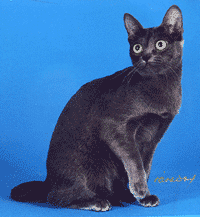
src:wikipedia. Photo of Miska, female Silver-tipped blue, Owner: Thea Robinson |
Appearance
Native to Thailand the Korat is a distinctive breed. This blue breed of cat is distinctive; because whoever owns one is considered to have in their possession a lucky breed of cat. The blue coat is actually silver tipped, making the Korat unlike any other “blue breed of cat.”
If you look at the Korat head on, you will see three hearts; the head is shaped like a valentine, looking down from the top of the Korat’s head, you will see a second heart. The third heart is the shape of the If you look at the Korat head-on, you will see three hearts; the head is shaped like a valentine, looking down from the top of the Korat’s head, you will see a second heart. The third heart is the shape of the Korat’s nose. Then if the cat is sitting in a prone position, you will observe a fourth heart on the chest. Of course, beating within this intelligent cat is the fifth heart.
History
The Korat was first discovered in Ampur Pimai of the Korat Province of Thailand. In a book first printed in 1305 you will find a poem dedicated to this extraordinary animal; The Cat Book of Poems. This book is now located in the National Library of Bangok.
The good luck of this cat is said to increase if the cat has a kink in its tail. In 1959 the first two Korats were imported to the United States, sent to an Oregon cattery; Cedar Glen Cattery. Seven years later, the Korat was officially recognized in the CFA into the Championship status.
Personality
Highly intelligent, curious and at time mischievous, Korats are busy becoming the center of your universe. Able to open up cupboards, locate hidden treats and organize your home in their cat-like manner, Korats are reported to be a delight to own.
They love to play, are extremely fast, agile and athletic. They have a sharper sense of smell than most other cats and even after being caught in the act doing something they know they shouldn’t, they manage to give you such a look at love that you soon forget your irritation.
Health/Genetic Traits
Until 1998, a few Korat kittens fell victim to a horrible genetic disease called Gangliosidosis. When this disease first began, a concentrated effort was made by a group of breeders to overcome this neurological disorder. Today, this disease is almost nonexistent thanks to a test developed by Dr. Harry Baker and his team at the Scott Ritchey Research Center at Auburn University in Albany, Alabama.
Finding a Kitten
Korat breeders adhere to strict guidelines when releasing a kitten. There is an official “Korat Pledge” that all breeders insist potential buyers read and agree to before purchasing a kitten. The pledge reminds the future owner that the Korat should only be an inside kitty, spayed at the age of 6 months unless sold for breeding purposes, and never sold to a pet store or taken to a shelter. The kitten is not released to the new home until the kitten is 10 weeks old. Korats do not fully mature until they are five years old. Makes for a fun time in the household.
Entertainment Factor
The Korat is an easy cat to harness train. They love to play fetch, and will play longer than your arm can throw the toy. Left to their own devices, they will entertain themselves. One Korat owner decided since her cat loved to be in the bathroom the same time as she was, that installing a cat door in the bathroom door was the way to go. Her Korat, Thea, now makes it a practice to sit on the ledge of the shower stall while she takes a shower. Thea bats at the water drops on the shower door in an attempt to chase the beads of water. When Liz added a bubble maker to her shower then the real fun started.
Mary Anne Miller is a free lance writer, website content provider and member of The Cat Writers’ Association.
 |
More cat breeds |
 |
|



? Copyright 2006-2010 Felinexpress.com, All Rights Reserved
Privacy Statement - Disclaimer - About Me